





The reluctance of construction industry to hire people with criminal convictions revealed

Negative stigma and a lack of proper training opportunities are blocking many people with criminal records from earning a second chance at life within the construction industry, a Chartered Institute of Building (CIOB) report has revealed.
The report, called Building Opportunity: Employing People with Criminal Convictions in Construction, shows individuals with a criminal record face significant barriers to gaining employment within the industry including perceived risk to the business by employers and fears about business reputation.
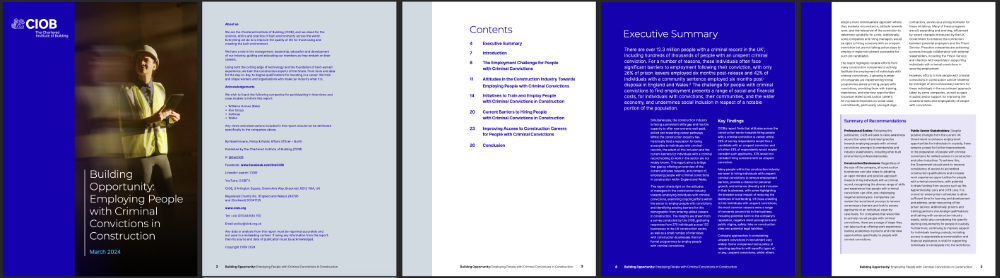
It urges the Government to break down barriers and provide more accessible training opportunities to improve individual’s employability and ease the skills shortage in the construction industry.
Statistics show nearly 75 per cent of people leaving prison are still without work six months after their release. CIOB says breaking down barriers would lower unemployment amongst people with criminal convictions. Meanwhile, the Government estimates the current cost of re-offending is approximately £18 billion per year.
Niamh Evans, Policy and Public Affairs Officer North at CIOB, said more people within the industry should consider an open-minded approach to hiring people looking for a fresh start, adding: “Construction companies across the UK are facing a labour shortage and there is an untapped market of potential candidates waiting to be unearthed.
“However, negative stigma and a lack of access to proper training for people in prison means there are many people missing out on a second chance at life.
“Companies can proactively show they are willing to consider applicants with a criminal record by making this known on their website and teaming up with organisations that support people with criminal convictions to find work.
“While there are some training opportunities available for people with criminal convictions, we would like to see improved access to give more candidates a chance to develop their skills ahead of a rewarding career within construction.”
CIOB’s research shows just 25 per cent of construction managers surveyed* would consider hiring a person with an unspent criminal conviction – despite the sector facing a significant labour crisis.
Thirty-two per cent of respondents said they would not consider hiring someone with an unspent criminal conviction while 43 per cent said they might.
More than 12 million people in the UK currently have a criminal record with hundreds of thousands of convictions remaining unspent – so candidates must declare their convictions when applying for a job.
Some survey respondents said they would not hire people with criminal convictions due to the lack of trust in an individual’s behaviour and concerns over existing employees’ safety, particularly in a high-risk environment like a construction site.
Despite this CIOB’s report highlights how some construction companies have already enjoyed success through hiring people with criminal convictions and specifically showcases how one large construction company and one much smaller one, are being proactive in this area.
They include Williams Homes, based in Bala, Wales, which has taken on several recruits through its work with HMP Berwyn.
Owain Williams, joint managing director, added: “Our initiative to provide work experience and training to individuals in our local prison has been incredibly successful. We have gained loyal workers and we have been able to tailor our supply chain to meet the company’s needs, whilst giving back to the community.
“Everyone working in the prison academy and on-site through temporary release receives a high standard of training. Our colleagues and clients have all supported and embraced the project as it allows us to make an immense difference to the lives of people leaving custody by broadening their career opportunities.
“As we have had such a positive experience with this initiative, we are now exploring how to scale up this work and employ more people following their release from prison.”
It is estimated 225,000 additional construction workers will be needed to meet demand by 2027, according to data from the Construction Industry Training Board (CITB).
Demand for construction work is likely to increase in the years ahead with significant plans for the regeneration of the built environment in the UK, particularly with the Government’s flagship levelling up agenda and political focus on delivering a faster rate of housebuilding.
CIOB obtained its data through a survey of more than 130 construction companies across the UK. To read the report in full, visit: www.ciob.org/industry/research/criminal-convictions-employment
This article appears on the CIOB news and blogsite as "Construction's reluctance to hire people with criminal convictions revealed" dated March 14, 2023.
--CIOB
[edit] Related articles on Designing Buildings
- Apprenticeships for prisoners.
- Building back better with apprenticeships.
- CIOB aims to help ex-offenders build a career in construction.
- Construction apprenticeships.
- Ex-offender Community.
- Industry work placement.
- Projects deliver meaningful change at young offenders institution.
- Non-residential institution.
- Residential institution.
- Secure residential institution.
- Tackling the construction skills shortage.
Featured articles
Check out some of the best features and news from Designing Buildings as well as key stories from around the web.

Government approach could undermine delivery and regeneration.
World's first mass timber data centre.

The overlooked environmental aspect of data centre development.
Introduction to radon awareness

New technical information sheet published by CIOB.

Updated supplier guide can help electrical contractors engage with NHP.

CIAT confirm the winners of the 2026 architectural technology awards.

Government launches a one stop shop for flood preparedness.

Sir Edwin Lutyens: Britain's greatest architect? Book review.

CIOB publishes free template to help assess and manage risks.
ECA's reflections on Party Conference season

Burnham wants to be confident of winning before asking for a fresh mandate.
New Chief Construction and Scientific Adviser

Sergio Cavalaro, Professor of Infrastructure Systems at Loughborough University.
Building safety levy for England

CIAT publish estimator tool for members.

Water sector faces a growing crisis that could slow the delivery of vital infrastructure.